Showing posts from Product Management category

How to Add an AI Assistant to Your Existing SaaS Application Using MCP

How to Add an AI Assistant to Your Existing SaaS Application Using MCP

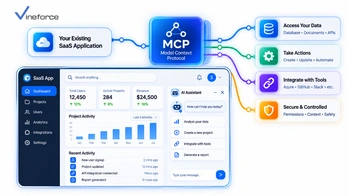
SaaS founders, CTOs, and product managers are facing intense pressure to add generative AI capabilities to established software platforms. However, rebuilding production applications from scratch to support AI chatbots is expensive, risky, and unnecessary. The [Model Context Protocol (MCP)](https://modelcontextprotocol.io/) enables engineering teams to retrofit an AI assistant into an existing SaaS application by wrapping existing APIs and [Microsoft SQL Server](https://www.microsoft.com/en-us/sql-server) business data. > **Quick Summary:** Adding an AI assistant to a live SaaS platform does not require replacing your existing technology stack. By implementing a lightweight [MCP server](https://modelcontextprotocol.io/) layer that bridges your front-end chat widget, Azure OpenAI, and existing backend REST APIs, you can deliver natural-language data queries and automated workflows while maintaining existing user permissions, multi-tenant isolation, and business logic. --- Table of Contents - [The Challenge of Retrofitting AI into Production SaaS](#the-challenge-of-retrofitting-ai-into-production-saas) - [Target Retrofit Architecture: The MCP Layer Pattern](#target-retrofit-architecture-the-mcp-layer-pattern) - [Step-by-Step Implementation Roadmap](#step-by-step-implementation-roadmap) - [Step 1: Audit Existing APIs & Identify High-Value Tools](#step-1-audit-existing-apis--identify-high-value-tools) - [Step 2: Build the ASP.NET Core MCP Adapter Layer](#step-2-build-the-aspnet-core-mcp-adapter-layer) - [Step 3: Connect to Azure OpenAI Service](#step-3-connect-to-azure-openai-service) - [Step 4: Integrate Front-End Chat Widget & Authentication](#step-4-integrate-front-end-chat-widget--authentication) - [Managing User Context, Permissions, and Multi-Tenancy](#managing-user-context-permissions-and-multi-tenancy) - [Handling Read vs. Write AI Actions (Human-in-the-Loop)](#handling-read-vs-write-ai-actions-human-in-the-loop) - [Monitoring, Auditing, and Rate Limiting](#monitoring-auditing-and-rate-limiting) - [Frequently Asked Questions (FAQ)](#frequently-asked-questions-faq) - [Conclusion](#conclusion) --- The Challenge of Retrofitting AI into Production SaaS Adding AI features to an established SaaS application presents distinct engineering requirements: 1. **Preserve Production Stability**: New AI features must not destabilize core application databases or microservices. 2. **Maintain Security & Multi-Tenancy**: The AI assistant must strictly respect individual user role permissions and tenant boundaries. 3. **Speed to Market**: Product teams need to ship working AI capabilities in weeks, not quarters. ``` [ Traditional Approach (High Risk) ] Re-architect whole app ---> Rewrite APIs for LLM ---> Re-implement Auth ---> 6-12 Months Delay [ MCP Adapter Approach (Low Risk) ] Existing SaaS UI + APIs ---> Add MCP Microservice Adapter ---> Azure OpenAI ---> 3-4 Weeks Deployment ``` To review protocol fundamentals before planning your SaaS rollout, read our overview on [what Model Context Protocol (MCP) is](/what-is-model-context-protocol). --- Target Retrofit Architecture: The MCP Layer Pattern Rather than refactoring existing backend controllers, insert a lightweight MCP adapter service between your frontend AI chat UI and backend APIs: ``` [ User Browser / SaaS UI ] | +---> 1. Sends Natural Language Query ("Show overdue accounts") v [ AI Chat Widget / Agent Host ] | | 2. Sends Prompt + User JWT Token v [ Azure OpenAI Service ] <===> [ ASP.NET Core MCP Server ] | | 3. Executes Tool via HTTP (Passes JWT) v [ Existing SaaS REST API Layer ] | v 4. Applies Existing DB Rules [ SQL Server / Azure SQL DB ] ``` --- Step-by-Step Implementation Roadmap Step 1: Audit Existing APIs & Identify High-Value Tools Review your SaaS application's REST API endpoints and select 5 to 10 high-value endpoints to expose as AI tools first: - 📊 **Reporting & Analytics**: `GET /api/v1/reports/sales-summary` -> Tool: `get_sales_summary` - 🔍 **Search & Lookup**: `GET /api/v1/customers/search` -> Tool: `search_customers` - 📑 **Document Retrieval**: `GET /api/v1/invoices/{id}` -> Tool: `fetch_invoice_details` Step 2: Build the ASP.NET Core MCP Adapter Layer Implement a lightweight .NET 9 MCP service that forwards tool calls to your production REST APIs: ```csharp public class SaasCustomerMcpTools { private readonly HttpClient _apiClient; public SaasCustomerMcpTools(IHttpClientFactory httpClientFactory) { _apiClient = httpClientFactory.CreateClient("SaaSBackendApi"); } [McpTool("search_customers", "Searches customer accounts by partial name or account code.")] public async Task<CustomerSearchResponseDto?> SearchCustomersAsync(string query, HttpContext httpContext) { // Extract original User Bearer Token from HTTP request headers var authHeader = httpContext.Request.Headers["Authorization"].ToString(); var request = new HttpRequestMessage(HttpMethod.Get, $"/api/v1/customers/search?q={Uri.EscapeDataString(query)}"); request.Headers.Add("Authorization", authHeader); // Propagate user identity! var response = await _apiClient.SendAsync(request); response.EnsureSuccessStatusCode(); return await response.Content.ReadFromJsonAsync<CustomerSearchResponseDto>(); } } ``` For detailed architectural code examples, read our guide on [building an MCP server with .NET](/mcp-server-dotnet). Step 3: Connect to Azure OpenAI Service Configure your host agent application to send user prompts to Azure OpenAI, passing your MCP server's tool definitions inside the API call. To explore cloud architectural topologies, review our guide on [Azure OpenAI + MCP enterprise integration](/azure-openai-mcp-business-data). Step 4: Integrate Front-End Chat Widget & Authentication Embed an AI assistant slide-out panel into your existing SaaS web frontend (React, Angular, or Vue). When the user opens the panel, pass their current session authentication token to the AI backend. --- Managing User Context, Permissions, and Multi-Tenancy > **CRITICAL SAAS SECURITY PRINCIPLE:** The AI assistant must never have elevated privileges beyond the user interacting with it. By passing the authenticated user's JWT token through the MCP tool handler to your underlying REST APIs, your existing role-based access controls (RBAC) and multi-tenant filters automatically execute. If an unprivileged user asks the AI assistant to view payroll data, the underlying API returns `403 Forbidden`, and the AI assistant cleanly informs the user that they lack authorization. For multi-tenant specific guidance, see our deep dive on [MCP for multi-tenant SaaS: keeping customer data isolated](/mcp-multi-tenant-saas). --- Handling Read vs. Write AI Actions (Human-in-the-Loop) While data querying tools can run automatically, state-changing actions (such as sending emails, approving refunds, or deleting records) should implement **Human-in-the-Loop (HITL)** UI confirmations: ``` [ AI Assistant ] -> "I generated a draft refund of $150 for Customer X. Do you approve?" [ User Clicks ] -> [ ✅ Approve & Execute ] | [ ❌ Cancel ] ``` This prevents accidental automated modifications triggered by LLM misunderstandings. --- Monitoring, Auditing, and Rate Limiting Track usage patterns, token costs, and tool invocation latency across your SaaS tenant base: ```json { "Timestamp": "2026-09-11T11:05:00Z", "TenantId": "tenant_corp_771", "UserId": "usr_9912", "ToolInvoked": "search_customers", "BackendApiStatusCode": 200, "LatencyMs": 142 } ``` For SaaS founders planning MVP launches, explore our analysis on [how long it takes to build a SaaS MVP](/how-long-does-it-take-to-build-a-saas-mvp). To accelerate your AI assistant rollout without risking production stability, explore [Vineforce AI Database Integration Solutions](https://www.vineforce.net/solutions/ai-database-integration-mcp/). --- Frequently Asked Questions (FAQ) Do I need to rewrite my SaaS backend to add an AI assistant using MCP? No. The main advantage of Model Context Protocol (MCP) is that it acts as a lightweight middleware layer. You can expose existing REST APIs, database queries, and microservices as MCP tools without modifying core backend application code. How does user authentication work when an AI assistant calls MCP tools? The AI assistant chat component passes the current user's authenticated OAuth 2.0 / Entra ID JWT Bearer token to the MCP server. The MCP server validates the token and enforces the user's existing permissions before executing any tool. Can an AI assistant execute actions (like creating invoices or updating tickets) via MCP? Yes. MCP supports read tools (fetching data) and write tools (executing actions). For write tools, best practice involves adding human-in-the-loop confirmation prompts in the UI before executing state-changing API calls. How long does it typically take to retrofit an AI assistant into an existing SaaS app using MCP? Because MCP reuses existing APIs and authorization pipelines, prototyping an initial MCP assistant for a production SaaS platform can be achieved in a few weeks rather than months of ground-up development. --- Conclusion Retrofitting an AI assistant into an established SaaS platform does not require risky architectural overhauls. By deploying a Model Context Protocol (MCP) adapter layer over existing REST APIs and databases, SaaS companies can rapidly ship intelligent natural-language features while preserving security, multi-tenancy, and stability. Need help connecting your existing application or business data with AI? [Vineforce](https://www.vineforce.net/solutions/ai-database-integration-mcp/) can help design and implement a secure MCP architecture around your existing databases, APIs, authentication, authorization, and business rules.