What Should a CA Firm Include on Its Website?
- Harsh Gupta
- 21 Sep, 2026
- 10 Mins read
- Development , Web Design
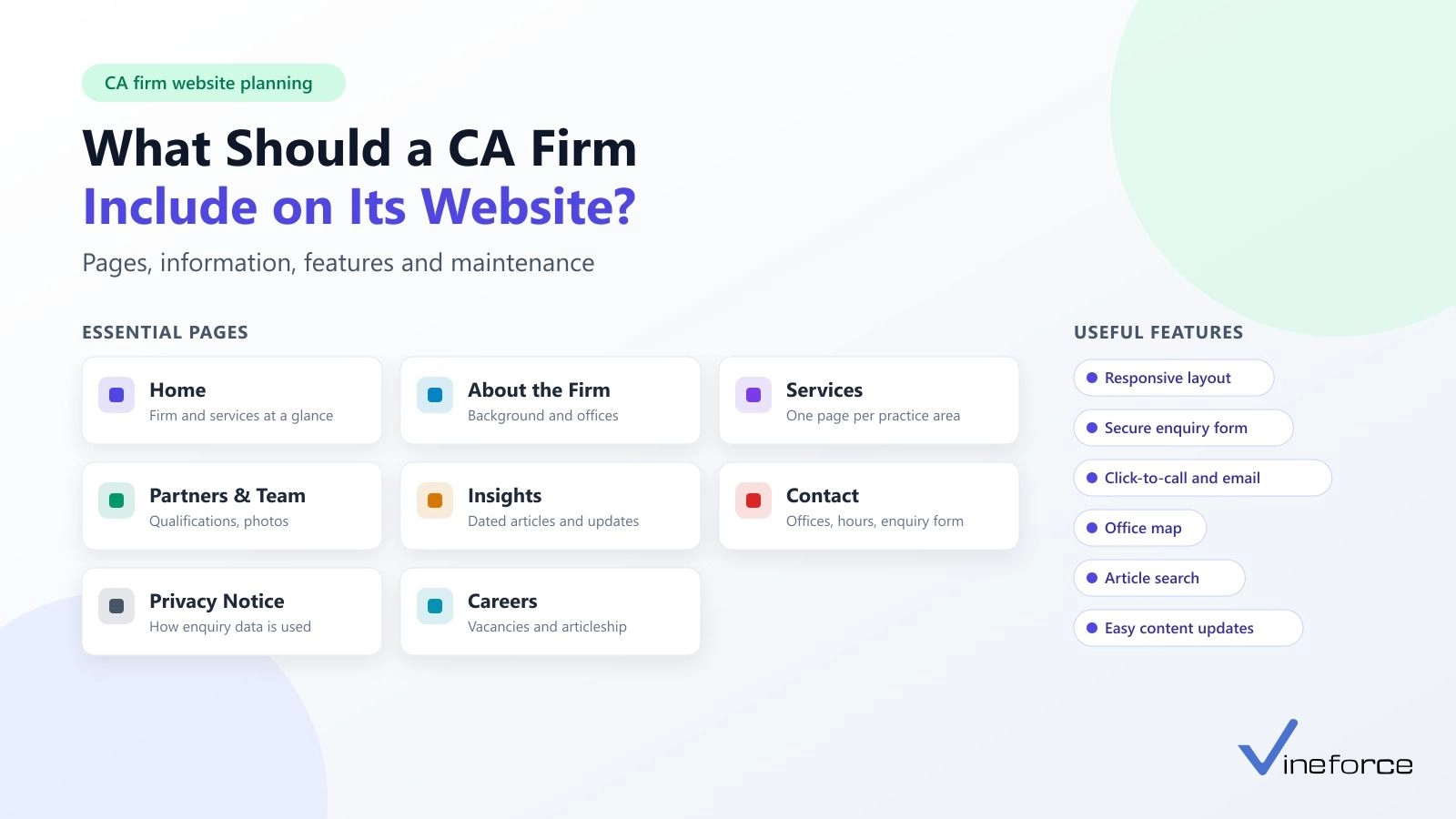
A CA firm website should include a clear home page, an about the firm page, a services section, partner and team profiles, a contact page with a working enquiry form, and a privacy notice. Many firms also add an insights section for articles and a careers page. Beyond the pages, visitors should be able to find out quickly who the firm is, what it does, where its offices are, and how to get in touch.
Quick Summary: Build your CA firm website around the particulars ICAI permits (firm details, services, partners, offices, peer review status) and make contact easy. Add useful features such as mobile-friendly layouts, a secure enquiry form and click-to-call links. Treat client portals, booking systems and chatbots as optional. ICAI does not prescribe a website format, and this guide separates ICAI-related points from general best practice. It is not legal advice.
This article is part of a series. For planning and building the site under the current ICAI rules, read how to build a website for a CA firm under ICAI guidelines. For auditing an existing site, read common website mistakes CA firms should review. This one focuses on what to put on the website.
What Makes a CA Firm Website Useful?
A useful website answers five questions within a minute:
- Who is the firm? Name, registration, partners, offices.
- What does it do? Services, in plain language.
- Who does it work with? Individuals, businesses, NRIs, trusts, and so on.
- How do I contact it? Phone, email, address and a form that works.
- Is this relevant to me? Service pages and articles that match the visitor’s need.
The aim is not an online brochure. It is accurate information, organised so people can find it, with a clear path to an enquiry.
ICAI gives firms flexibility here. Paragraph 3.3.2 of the website guidelines says the format of the website “is not being prescribed”. The guidelines form part of the Council Guidelines for Advertisement, 2008, reproduced in Volume I of the ICAI Code of Ethics, 2026. The 13th Edition is applicable from 1 April 2026.
Essential Pages a CA Firm Should Consider
These are suggested sections, not a list of legally required pages.
1. Home Page
The home page orients visitors. Include:
- The firm name with “Chartered Accountants”
- A short, factual description of what the firm does
- The main service categories, each linking to its own page
- Office locations or the area the firm serves
- A phone number, email and a link to the contact page
Keep it simple. A visitor should reach any service page or the contact page in one click.
2. About the Firm
Give the facts: year of establishment, offices, number of partners, the firm’s areas of work, and network affiliation if any. ICAI permits peer review status and Audit Quality Maturity Model (AQMM) level to be displayed (para 3.3.7(iv), (v)).
Describe the firm’s approach in plain terms, such as how engagements are handled or which sectors the firm works with. Avoid comparisons with other firms and claims you cannot support.
3. Services
This is usually the most important section for visitors and search engines.
- Group services into a few clear categories, such as direct tax, GST, audit and assurance, company law compliance, accounting and advisory.
- Give each significant service its own page.
- Explain each service in plain language: what it covers, who typically needs it, and what the client should prepare.
- List only services the firm actually provides.
An example: a “GST services” page might cover registration, return filing, annual returns, reconciliations and departmental notices. It would say who usually needs each one, and link to a relevant article on the insights section.
Under para 3.3.3, services exclusively reserved for Chartered Accountants, such as statutory audit, may be shown only on a “pull” basis. Pull means the visitor goes looking for the information; it is not pushed out to them. Other services may also use “push” technology. If you are unsure how this applies to your service pages, check with a qualified professional.
4. Partner and Team Profiles
For each partner, show the name, qualifications, areas of experience and contact details, with a passport-style photograph (para 3.3.7(viii), 3.3.9). Employee details may be included on similar lines (para 3.3.7(ix)).
Use only designations the Code permits. Para 2.14.1.7(ii) of the Code notes, for example, that describing a CA in practice as an “Income-tax Consultant” or “Management Consultant” on professional documents is improper.
5. Contact Us
Include:
- Verified phone numbers and email addresses
- Head office and branch addresses
- Working hours
- A short enquiry form asking only for name, contact details and a brief description
- Map links or directions for each office
6. Insights, Articles and Resources
Paragraph 3.3.10 permits blogs, articles, professional updates and educational videos on topics of professional relevance. A good insights section:
- Dates every article and shows when it was last reviewed
- Updates or archives articles when the law changes
- States clearly that articles are general information, not advice for a specific case
7. Privacy Notice and Other Policies
If the site collects personal data through forms, analytics or cookies, explain what is collected, why, and how long it is kept. The Digital Personal Data Protection Act, 2023 may apply; see the MeitY data protection framework and take legal advice on what your firm needs. Terms of use and a cookie notice are worth considering, but which policies are legally required depends on what your site does.
Optional: Careers
Job vacancies, including articleship openings, and the number of articled assistants may be displayed (para 3.3.7(x), (xi)). For many firms, this page brings in useful applications.
What Information Should a CA Firm Publish?
Paragraph 3.3.7 of the website guidelines lists the information that may be displayed. It is a practical content plan in itself:
| Information | Where it usually goes | Code of Ethics, 2026, Vol. I |
|---|---|---|
| Firm name, network or alliance name | Header, home page | Para 3.3.7(i) |
| Year of establishment | About page | Para 3.3.7(ii) |
| Head office and branch addresses, phone, email | Contact page, footer | Para 3.3.7(iii) |
| Peer review status and AQMM level | About page | Para 3.3.7(iv), (v) |
| Nature of services | Services pages | Para 3.3.7(vi), (vii) |
| Partner details (qualifications, experience areas, contact) | Partners page | Para 3.3.7(viii) |
| Employee details | Team page | Para 3.3.7(ix) |
| Job vacancies and articled assistants | Careers page | Para 3.3.7(x), (xi) |
| Network affiliation | About page | Para 3.3.7(xii) |
| Client name and nature of assignment, with client permission | About or services page | Para 3.3.7(xiii) |
| CA India logo | Header | Para 3.2.1; Code para 2.14.1.7(xviii) |
| Existing or past elected ICAI positions | Partner profiles | Para 3.3.19 |
Two limits apply to that list. Fees cannot be shown, except where a regulator requires disclosure. For services reserved for Chartered Accountants, only the client name may be mentioned, not the nature of the assignment.
Keep every item accurate. Paragraph 3.3.21 says website information should not be at material variance from ICAI’s records. Never publish confidential client information, and keep written consent before naming any client.
Useful Website Features for CA Firms
Essential
- Responsive design. Pages adjust to phones, tablets and desktops.
- Clear navigation. A short menu with services grouped sensibly.
- Secure enquiry form. Served over HTTPS, with spam protection, sending to a firm-controlled mailbox.
- Click-to-call and email links. One tap on a phone starts a call or an email.
- Office maps or directions.
- Easy content updates. Staff can edit profiles and publish articles without a developer.
- Backups and security updates.
Optional, when there is a real need
- Site search, for firms with a large article library.
- Consultation request form, for firms that schedule first meetings. Keep the wording neutral.
- Downloadable public resources, such as compliance calendars or document checklists.
- Analytics, to see which pages people use, set up with a privacy notice and consent where needed.
- Client document portal. ICAI permits a document management facility with distinct login and password (para 3.3.11). It needs proper security and is not necessary for every firm.
- Online advice on request. Para 3.3.13 allows online advice to clients who specifically ask for it.
Online payments, appointment booking systems and AI chatbots are not needed by most firms. The Code does not address payment gateways or public chatbots directly, so review them with a professional before adding them. Para 3.3.11 covers chat between members and with clients, subject to confidentiality.
Trust and Professional Presentation
Trust on a CA website comes from accuracy and clarity, not promotional claims. The Code sets conditions for any “write-up”, which includes websites (para 3.1.2, 3.1.3):
- Content must be honest and truthful, with no exaggerated claims about services, qualifications or experience.
- No disparaging references or unsubstantiated comparisons with other firms.
- No testimonials or endorsements.
- No awards, except those given by Central or State Governments or regulatory bodies, and no accreditations granted by any organisation.
- No monograms or catchwords.
- No banner advertisements on the website (para 3.3.16).
Some items are less clear. Client logos are not in the para 3.3.7 list, and ICAI’s 2020 website advisory listed them as prohibited. Stock photography is not directly addressed. Review both with a qualified professional.
Give one partner ownership of the website content. ICAI states in para 3.1.1 that it will neither approve a proposed write-up nor own responsibility for its contents, so review happens inside the firm.
SEO Foundations for a CA Firm Website
Search engine optimisation (SEO) means making your pages easy for search engines to understand and useful to the people who find them. On a CA website, that comes down to:
- One page per major service, with original, useful content.
- Accurate page titles and meta descriptions that describe each page, such as “GST Services in Patiala | Firm Name, Chartered Accountants”.
- Logical headings and internal links between related services and articles.
- Location information on contact and service pages, where the firm serves a specific area.
- Fast, mobile-friendly pages. Check them with PageSpeed Insights.
- Descriptive alt text for partner photos and diagrams.
- Crawlability. An XML sitemap, and Google Search Console to spot indexing problems.
- Consistent contact details wherever the firm is listed.
On listings, the Code allows members to list on Government or regulator platforms and encourages use of ICAI’s CA Connect portal. It does not allow listing on app-based aggregators for services reserved for Chartered Accountants (para 3.5). Business listings such as Google Business Profile are not addressed directly, so check before creating one.
SEO cannot guarantee rankings or enquiries. Paid search ads and outbound promotion raise separate questions under para 3.3.5, which bars material soliciting people to visit the website. Take advice before using them.
Security, Privacy and Maintenance
These are general best practices unless a source is cited:
- HTTPS on every page
- Platform, theme, plugin and dependency updates applied regularly
- Separate admin accounts with multi-factor authentication; access removed when people leave
- Spam protection and server-side validation on forms
- Automatic off-site backups, tested by restoring
- Collect only what the form needs; never ask for PAN, bank details or documents through a basic enquiry form
- A defined retention period for enquiry data
- Adequate secrecy of client matters handled through the website (ICAI requirement, para 3.3.15)
- A quarterly review of content, links, contact details and time-sensitive articles
CA Firm Website Checklist
[ICAI] = supported by the Code of Ethics, 2026. [Review] = needs professional judgement. [Best practice] = general website guidance. This checklist is not legal advice or a guarantee of compliance.
Essential information and pages
- Home, About, Services, Partners, Contact and Privacy pages planned [Best practice]
- Particulars limited to items permitted in para 3.3.7 [ICAI]
Professional accuracy and content review
- Details match ICAI records [ICAI, para 3.3.21]
- No testimonials, exaggerated claims, catchwords or monograms [ICAI, para 3.1.3]
- Client names only with permission; no fees shown [ICAI, para 3.3.7(xiii)]
- Client logos, stock images and listings reviewed [Review]
User experience and mobile usability
- Pages, menus and forms work on phones [Best practice]
- Any service reachable in one or two clicks [Best practice]
Contact and enquiry handling
- Form delivers to a firm mailbox, with spam protection [Best practice]
- Click-to-call, email and map links tested [Best practice]
SEO and discoverability
- Unique titles and descriptions; one page per major service [Best practice]
- Sitemap submitted and indexing checked [Best practice]
Security, privacy and maintenance
- HTTPS, updates, MFA and tested backups [Best practice]
- Client matters kept confidential on any portal or chat [ICAI, para 3.3.15]
- Privacy notice and data retention reviewed [Review]
- Named content owner and review schedule [Best practice]
How to Prioritise Your Website
Not every firm needs the same scope, budget or technology.
- Starting out: accurate firm details, a services page, partner profiles, a contact page, mobile-friendly layout, HTTPS and basic SEO. A small, well-structured site is enough.
- Established firm: individual service pages, a regularly updated insights section, cleaner navigation, better enquiry handling, and a maintenance routine.
- Firm investing further: a broader content plan, analytics, a secure client document portal, or integrations with practice software, where there is a genuine workflow need.
How Vineforce Can Help CA Firms
Vineforce is a software engineering company that builds and runs its own products, such as Vineforce Teams, and builds websites and applications for clients. For CA firms, we help plan the page and service structure, build responsive and fast websites, set up SEO-friendly technical foundations, configure secure enquiry forms, and maintain the site where that is part of the agreed scope.
Our CA firm website development page explains how we map each planned page to the current ICAI website guidelines and flag items for the partners to review. We are not affiliated with or endorsed by ICAI, and we cannot certify compliance. Your firm reviews and approves all professional content. For projects beyond CA firms, see our web development services.
Frequently Asked Questions (FAQ)
What pages should a CA firm website have?
Most CA firms should consider a home page, an about the firm page, a services section, partner and team profiles, a contact page with office details and an enquiry form, and a privacy notice. An insights section for articles and a careers page for vacancies and articleship are useful additions. ICAI does not prescribe a website format, so the right set of pages depends on the firm.
What information can a CA firm show on its website under ICAI guidelines?
Paragraph 3.3.7 of the website guidelines in the ICAI Code of Ethics, 2026 lists items such as the firm name, year of establishment, office addresses and contact details, peer review status, AQMM level, nature of services, partner and employee particulars, job vacancies, number of articled assistants and network affiliation. Client names may be shown only with client permission, and fees cannot be shown except where a regulator requires disclosure.
Can a CA firm publish articles and blogs on its website?
Yes. Paragraph 3.3.10 of the ICAI website guidelines permits blogs, articles, professional information, professional updates and educational videos on topics of professional relevance. Articles should carry a date, be reviewed when laws change, and make clear that they are general information rather than advice for a specific client.
Does a CA firm website need a client portal or online payments?
No. A client portal, online payments, appointment booking or a chatbot are optional features. They make sense only when the firm has a clear workflow need and can operate them securely. ICAI permits a document management facility with distinct login and password for clients, but it is not required.
Should a CA firm show testimonials or client logos on its website?
The ICAI advertisement guidelines state that a write-up, which includes a website, should not contain testimonials or endorsements. Client logos are not among the items listed as permitted, and an older 2020 ICAI advisory listed them as prohibited. Firms should treat both as needing professional review before publication.
When should a CA firm update its website content?
Update the website whenever partners, offices, contact details or services change, and review time-sensitive articles whenever the underlying law changes. Paragraph 3.3.21 of the ICAI website guidelines says website information should not be at material variance from ICAI’s records.
Conclusion
An effective CA firm website gives accurate professional information, explains services clearly, makes contact easy, and stays usable, discoverable and current. Start with the pages your clients need most: services, partners and contact. Then add articles, careers or a portal as genuine needs appear.
When you are ready to plan the site, you can explore our approach to professional website development for Chartered Accountants.
This article is general information based on the ICAI Code of Ethics, 2026 as published on icai.org. It is not legal advice or an official ICAI interpretation. Verify the current provisions and consult a qualified professional before publishing professional content.