How to Build a Website for a CA Firm Under ICAI Guidelines (2026)
- Harsh Gupta
- 23 Oct, 2026
- 10 Mins read
- Development , Web Design
To build a website for a CA firm under ICAI guidelines, you plan a simple, factual site around the particulars ICAI allows, keep services reserved for Chartered Accountants on a “pull” basis, avoid testimonials, superlatives, logos and banner advertising, and have the partners review every page before it goes live. The technical work (hosting, design, security, SEO) is ordinary web engineering. The professional content is where Chartered Accountants need to be careful, because the website is treated as a “write-up” under ICAI’s advertisement guidelines.
Quick Summary: A CA firm website is permitted under the ICAI Code of Ethics, 2026 (13th Edition, applicable from 1 April 2026), but its content must follow the website guidelines in the Council Guidelines for Advertisement, 2008. Display factual particulars, describe services without exaggeration, get client consent before naming clients, skip testimonials and promotional awards, and get partner sign-off before launch. This article is a practical guide, not legal advice or an official ICAI interpretation.
This guide covers what changed in 2026, what the current text says about websites, how to structure the site, what to check before publishing, and how to handle design, security and SEO.
What Are the ICAI Website Guidelines?
The ICAI website guidelines are paragraphs 3.3.1 to 3.3.21 of the Council Guidelines for Advertisement, 2008, issued under Clause (7) of Part I of the First Schedule to the Chartered Accountants Act, 1949. They now sit in Volume I of the Code of Ethics, 2026 (pages 148 to 157 of the printed edition), updated up to December 2025.
Two things make them important:
- The guidelines define a “write-up” to include websites and social networking sites, in both push and pull mode. So the general advertising conditions (honest, truthful, no exaggerated claims) apply to your website too.
- Paragraph 3.3.14 states that if any content or technical feature of a website goes against the Code of Ethics or ICAI guidelines, ICAI may start disciplinary action, either suo motu or on a complaint.
What changed in the 13th Edition?
ICAI’s press release of 12 December 2025 announced the revised Code and its changes to advertisement and website provisions. The ICAI announcement dated 30 May 2026 confirms the 13th Edition is applicable from 1 April 2026, with one item applicable from 11 December 2025.
If you are redesigning an older site, do not rely on older checklists. ICAI’s 2020 advisory on website guidelines referred to the Code of Ethics, 2020, and some items on its list read differently from the current text. For example, the current Code permits:
- Push technology for services that are not exclusively reserved for Chartered Accountants (para 3.3.3).
- Client names, with client permission (para 3.3.7(xiii)).
- Photo galleries of professional events organised by the firm or where partners lecture (para 3.3.9).
- Awards given by Central or State Governments or regulatory bodies (para 3.1.3(F)).
- Existing or past elected positions in ICAI’s Central Council, Regional Councils and Branches (para 3.3.19).
Always work from the current text.
Why Should a CA Firm Plan Its Website Carefully?
A CA firm website does a few plain jobs. It confirms that the firm exists and is registered, says what services it offers, shows who the partners are, and tells people how to reach the right office. It can also host articles and professional updates for clients.
Careful planning matters for four reasons:
- Accuracy. Paragraph 3.3.21 requires that website information should not be at material variance from ICAI’s records. Old partner lists and closed branch addresses are a real risk.
- Confidentiality. Paragraph 3.3.15 requires adequate secrecy of client matters handled through the website. That covers enquiry forms, portals and email routing.
- Maintainability. Partners join and retire, and rules get revised. A site that only the original developer can edit tends to go out of date.
- Professional review. ICAI states in para 3.1.1 that it will neither approve a proposed write-up nor own responsibility for its contents. Your firm owns that review.
What Does ICAI Allow and Restrict on a CA Firm Website?
The table below summarises the verified provisions. Paragraph numbers refer to the Council Guidelines for Advertisement, 2008 in the Code of Ethics, 2026, Volume I.
| Website Element or Practice | Verified ICAI Requirement or Consideration | Practical Recommendation | Official Source |
|---|---|---|---|
| Firm and member particulars | Name, year of establishment, head office and branch addresses, phone, email may be displayed | Match every detail to ICAI records | Para 3.3.7(i) to (iii), 3.3.21 |
| Peer review and AQMM | Peer Review status and AQMM level may be displayed | Show only the current, verified status | Para 3.3.7(iv), (v) |
| Service descriptions | Nature of services may be shown; services exclusively reserved for CAs only on a specific “pull” request | Put reserved services (such as audit) behind a user action, not on auto-pushed content | Para 3.3.3, 3.3.4, 3.3.7(vi), (vii) |
| Partner and staff profiles | Name, qualifications, experience areas, contact details; passport-style photographs | Use passport-style headshots and factual descriptions | Para 3.3.7(viii), (ix), 3.3.9 |
| Photographs | Passport-style photos and photo galleries of professional events are permitted | Avoid non-professional event photos on the website | Para 3.3.9, 3.1.3(H) |
| Client names | Allowed with client permission, with nature of assignment; for reserved services, client name only; fees cannot be shown | Keep written client consent on file | Para 3.3.7(xiii) |
| Fees | Not to be displayed, except disclosure required by a regulator, with a prescribed italic note | Do not publish fee tables or “free consultation” offers | Para 3.3.7(xiii) |
| Testimonials | Write-up should not contain testimonials or endorsements | Do not add review widgets or quotes from clients | Para 3.1.3(E) |
| Awards and accreditations | No awards except those from Central or State Governments or regulatory bodies; no accreditations by any organisation | Remove private awards, rankings and certification badges | Para 3.1.3(F) |
| Logos and catchwords | Monograms and catchwords not permitted; CA India logo is allowed under its guidelines | Use a plain text firm name; no slogans | Para 3.1.3(G), 3.2.1; Code para 2.14.1.7(xvii), (xviii) |
| Claims and comparisons | No exaggerated claims, disparaging references or unsubstantiated comparisons | Avoid “best”, “leading”, “Why choose us” style copy | Para 3.1.3(A) to (D) |
| Articles and videos | Blogs, articles, professional updates and educational videos permitted | Build a knowledge section with dated articles | Para 3.3.10 |
| Client portal and chat | Document access with distinct login permitted; chat with clients subject to confidentiality | Use authenticated, encrypted access | Para 3.3.11, 3.3.15 |
| Banner advertisements | Not permitted on the website | No ad networks or third-party banners | Para 3.3.16 |
| External links | Links to ICAI, its Regional Councils and Branches, Government departments, regulators and other professional bodies are permitted | Review any other outbound link with a professional | Para 3.3.18 |
| Social media | Firm may link its social page but must not solicit people to visit or like it | Use a plain icon link, no “Follow us” prompts | Para 3.3.12 |
| Promoting the website | No circulars or advertisements soliciting visits; URL allowed on stationery and email | Do not run campaigns asking people to visit | Para 3.3.5 |
| Domain name | Should be as near as possible to the member or firm name and should not amount to solicitation | Prefer firm-name domains over keyword domains | Para 3.3.20 |
How to Plan the Website Structure
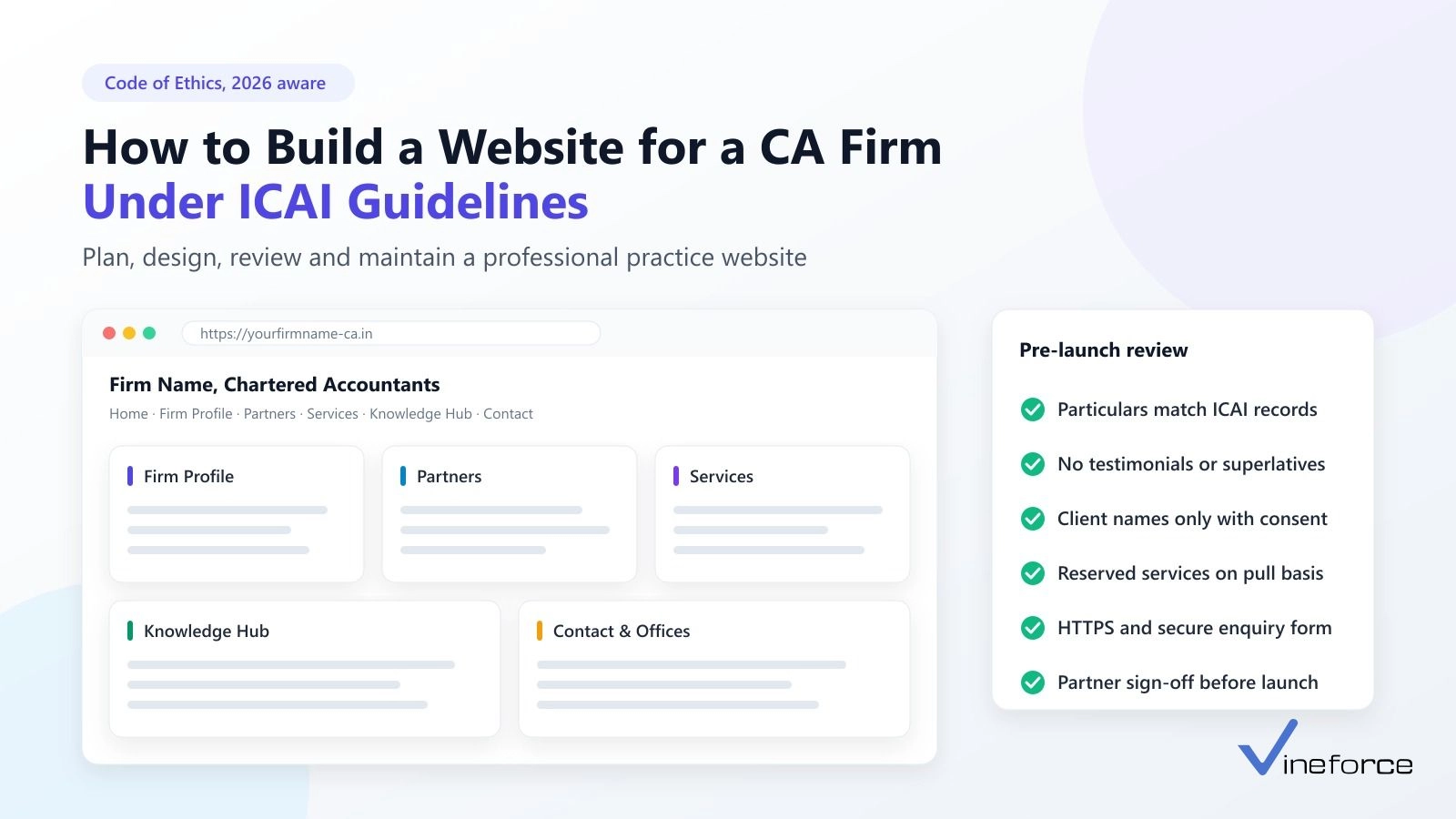
ICAI does not prescribe a format (para 3.3.2), so the structure depends on your practice. None of the pages below is mandatory under the guidelines. They are a sensible starting point for most small and medium firms.
- Home page. Firm name with “Chartered Accountants”, registration details where appropriate, a short factual description and office contacts.
- Firm profile. Year of establishment, offices, number of partners and staff, peer review status, network affiliation if any.
- Partners. One profile per partner with qualifications, areas of experience and a passport-style photograph.
- Services. A factual list of services. Plan how reserved services such as statutory audit are shown on a pull basis.
- Knowledge hub. Articles, compliance calendars and professional updates, each with a date and author.
- Careers. Job vacancies and articleship openings, which para 3.3.7(x) permits.
- Contact. Office addresses, working hours, phone numbers and a secure enquiry form.
- Privacy notice. How the enquiry form and any portal collect and use personal data.
If you are also planning internal tools for the practice, our page on software for accounting firms covers those needs separately.
How to Review Website Content Before Publication
Most problems on CA websites are content problems, not technical ones. Assign one partner to review every page against the current Code. Check these items in order:
- Firm name and registration details. They should match ICAI records exactly.
- Qualifications and designations. Use only the designations the Code permits. Para 2.14.1.7(ii) notes that titles such as “Income-tax Consultant” or “Management Consultant” are improper on professional documents for a CA in practice.
- Service descriptions. Describe what you do, not how good you are.
- Photographs and profiles. Passport-style photos; factual experience areas.
- Client references. Names only with recorded permission. Client logos are not listed among permitted items in para 3.3.7, and the 2020 advisory listed them as prohibited, so treat them as needing professional review.
- Awards, certifications and rankings. Remove anything outside the Government or regulator exception in para 3.1.3(F).
- Calls to action. Neutral wording such as “Contact our office” is safer than urgency or offers.
- Educational content and links. Articles should be educational, dated and accurate. Check outbound links against para 3.3.18.
Choosing the Right Website Design and Technology
None of the following is an ICAI requirement. These are engineering best practices that make a professional website usable, secure and easy to maintain.
- Responsive layout. Many visitors will open the site on a phone. Test on small screens.
- Clear navigation. Five to seven top-level items is usually enough.
- Accessibility. Follow WCAG 2.2 basics: good colour contrast, keyboard navigation, alt text and readable font sizes.
- Performance. A static site generator such as Astro, which this blog runs on, serves pre-built HTML that loads quickly and has a small attack surface.
- HTTPS and security headers. Use TLS everywhere and add a policy such as a Content Security Policy (CSP). Our guide on configuring TLS on Azure Web Apps covers common hosting errors.
- Secure enquiry forms. Collect only what you need, protect forms from spam, and route submissions to a firm-controlled mailbox.
- Content management. Partners or staff should be able to update profiles and articles without a developer. If you prefer WordPress, see our custom WordPress development guide.
- Backups and maintenance. Schedule backups, dependency updates and a yearly content review.
If the site collects personal data through forms or a portal, also consider the Digital Personal Data Protection Act, 2023, and take legal advice on what applies to your firm.
SEO Considerations for CA Firm Websites
Technical SEO means making a website easy for search engines to crawl, understand and display. It is different from promotion. Building a well-structured site is ordinary engineering; actively pushing people towards it may engage the solicitation and advertising restrictions.
Technical practices that improve how search engines read your site:
- A unique page title and meta description for each page, describing the content factually.
- One H1 per page and descriptive H2 and H3 headings.
- Clean URLs such as
/services/gst-advisory. - Internal links between related articles and service pages.
- Mobile-friendly layouts and fast load times.
- An XML sitemap and a correct
robots.txtso pages can be crawled. - Structured data (for example
AccountingServiceorOrganizationfrom Schema.org) that only repeats facts already visible on the page.
Paid search advertising, sponsored listings, promotional email campaigns and “rank higher” tactics are a different matter. The Code does not address search advertising specifically, but para 3.3.5 bars material soliciting people to visit the website, and Clause (6) of Part I of the First Schedule prohibits soliciting work “by any other means”. Get professional advice before using any paid or outbound promotion. No developer can guarantee rankings or enquiries, and you should be wary of anyone who does.
Common Website Planning Mistakes
- Outdated professional information. Retired partners, old addresses, an expired peer review status.
- Copying an older checklist. Using pre-2026 lists without checking the current Code.
- Template copy. Stock agency text with phrases like “trusted by 500+ clients” or “Why choose us”.
- Review widgets and logo walls. Imported from generic business templates without review.
- Careless client information. Naming clients without written consent, or emailing enquiry data to personal inboxes.
- Poor mobile usability. Tables and menus that break on phones.
- No owner. Nobody at the firm is responsible for keeping the site current.
A Practical Website Launch Checklist
Use this as a review aid. Completing it does not guarantee regulatory compliance.
- Current ICAI Code of Ethics and any recent announcements reviewed
- Firm name, registration and addresses match ICAI records
- Partner qualifications, photos and profiles checked
- Service descriptions factual; reserved services on pull basis
- No testimonials, fees, superlatives, catchwords, monograms or banner ads
- Client names published only with written consent
- Awards limited to Government or regulator awards
- Outbound links reviewed against para 3.3.18
- Mobile layout and accessibility tested
- Page titles, meta descriptions, sitemap and structured data in place
- HTTPS, security headers, secure forms and privacy notice in place
- Final approval by the partners, with professional advice where needed
- Maintenance owner and periodic review dates set
How Vineforce Can Help
Vineforce is a software engineering company. We build and run our own products, such as Vineforce Teams, and this blog itself is a static Astro site we build and maintain. That same engineering practice goes into client websites: planning, responsive development, content organisation, technical SEO, performance, security configuration and ongoing maintenance.
For CA firm website development, we map each planned page to the current ICAI website guidelines and flag items for your review. We keep reserved services on a pull model and set up the site so partners can update content themselves. We are not affiliated with or endorsed by ICAI, we do not give legal advice, and we cannot certify compliance. Your firm reviews and approves all professional content.
Our broader web development services cover projects beyond CA firms.
Frequently Asked Questions (FAQ)
Can a CA firm have its own website under ICAI guidelines?
Yes. Paragraph 3.3.1 of the Council Guidelines for Advertisement, 2008, reproduced in the ICAI Code of Ethics, 2026, states that Chartered Accountants, CA firms and registered networks are free to create their own website. ICAI does not prescribe a fixed format, but the content must follow the website guidelines and must not amount to soliciting clients.
What information can a CA firm display on its website?
Paragraph 3.3.7 allows details such as the firm name, year of establishment, office addresses and contact details, peer review status, AQMM level, nature of services, partner and employee particulars, job vacancies, number of articled assistants and network affiliation. Client names and the nature of assignments may be shown only with client permission, and fees cannot be shown except where a regulator requires disclosure.
Why can’t a CA firm website show client testimonials?
The Council Guidelines for Advertisement, 2008 state that a write-up should not contain testimonials or endorsements concerning members or the fees charged, and the definition of write-up includes websites. Testimonials are treated as promotional endorsements, which conflict with the restrictions on advertising and solicitation in the Chartered Accountants Act, 1949.
When should a CA firm review its website content?
Review content before launch, whenever partners, offices or services change, and whenever ICAI revises the Code of Ethics or issues new guidance. Paragraph 3.3.21 requires that website information should not be at material variance from ICAI’s records, so a periodic check against firm records is a sensible practice.
Does using a website developer make the website ICAI compliant?
No. A developer can build a secure, accessible and well-structured website, but responsibility for professional content stays with the member or firm. ICAI also states that it will neither approve a proposed write-up nor own responsibility for its contents, so partners should review and approve every page and seek professional guidance where a provision is unclear.
Conclusion
A good CA firm website is factual, current, easy to use and secure. Start from the current Code of Ethics, not an old checklist. Build the structure around the particulars ICAI permits, keep the engineering sound, and make partner review a step that happens before every change goes live.
If you are planning a new website or a redesign, you can read how we approach website development for CA firms or contact our team to discuss your requirements.
This article is general information based on the ICAI Code of Ethics, 2026 as published on icai.org. It is not legal advice or an official ICAI interpretation. Verify the current provisions and consult a qualified professional before publishing your website.