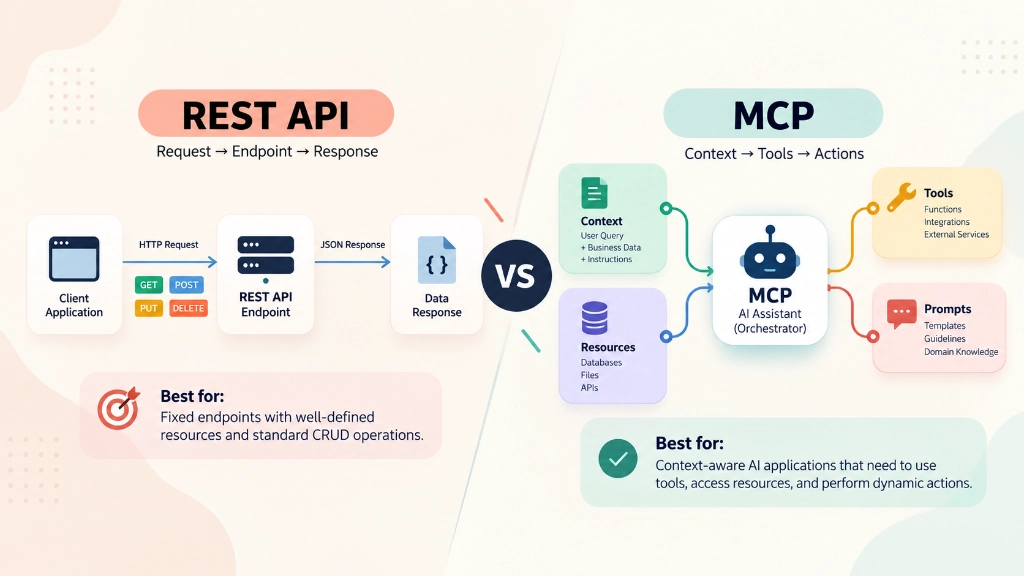
MCP vs REST API: What's the Difference and When Should You Use Each?
- Harsh Gupta
- 11 Sep, 2026
- 05 Mins read
- Architecture , APIs , AI
When MCP started getting traction in enterprise teams, the first question that came up was almost always the same: “Do we need to replace our REST APIs with this?” The short answer is no. But the longer answer is worth understanding, because the two technologies solve genuinely different problems and they work best together.
Quick Summary: Model Context Protocol (MCP) does not replace traditional REST APIs. REST APIs remain the gold standard for deterministic, application-to-application communication. MCP operates as a complementary AI integration protocol — acting as an intelligent adapter that translates dynamic LLM reasoning into structured calls against existing enterprise REST APIs and Microsoft SQL Server database layers.
Understanding the Core Difference
The clearest way to understand MCP vs REST is to look at who consumes each:
- REST (Representational State Transfer): Formulated in 2000, REST is an architectural style for hypermedia systems using standard HTTP verbs (
GET,POST,PUT,DELETE). A developer writes code that calls a known endpoint with a known payload structure. The behavior is deterministic — the same request always produces the same call path. - MCP (Model Context Protocol): Introduced by Anthropic in late 2024, MCP is an open specification using JSON-RPC 2.0. It standardizes how AI applications discover and invoke tools at runtime. The consumer is not a developer — it’s an LLM that reads tool descriptions and decides on its own whether to call them.
[ Traditional Web App Flow ]
React Frontend ---> HTTP GET /api/v1/orders/8841 ---> REST API Endpoint ---> SQL Database

[ AI-Driven MCP Flow ]
User Prompt ---> LLM Reasoner ---> Selects Tool "get_order_details" ---> MCP Server ---> Existing REST API Endpoint
If you want a solid foundation on MCP mechanics before digging into the comparison, our introduction on what Model Context Protocol (MCP) is covers the protocol from the ground up.
Side-by-Side Comparison: MCP vs. REST API
| Feature / Metric | REST API (OpenAPI / Swagger) | Model Context Protocol (MCP) |
|---|---|---|
| Primary Consumer | Software developers, web clients, mobile apps | LLMs, AI assistants, Autonomous agents |
| Execution Nature | Deterministic (Hardcoded workflow logic) | Dynamic (LLM decides tool invocation) |
| Protocol / Transport | HTTP/1.1 or HTTP/2 (GET, POST, etc.) | JSON-RPC 2.0 over stdio, SSE, WebSockets |
| Interface Schema | OpenAPI 3.0 / Swagger JSON | MCP JSON Schema (Tools, Prompts, Resources) |
| Statefulness | Typically Stateless | Connection-oriented (Bidirectional RPC) |
| Discovery Mechanism | Static build-time documentation | Runtime discovery (tools/list RPC response) |
| Primary Use Case | Web applications, integrations, CRUD services | AI context augmentation, natural language interfaces |
Key Architectural Differences Explained
1. Consumer Model: Human Code vs. LLM Reasoner
With a REST API, the developer knows the endpoint URL, the request structure, and the expected response shape before writing a single line of code:
// Programmatic REST API Client Call (Deterministic)
var response = await _httpClient.GetFromJsonAsync<OrderDto>("/api/v1/orders/8841");
With MCP, the LLM reads human-readable descriptions embedded in tool definitions at runtime and decides on its own whether calling a tool makes sense for the user’s request:
{
  "name": "get_order_details",
  "description": "Retrieves shipping status and item summary for an enterprise order ID.",
  "inputSchema": {
    "type": "object",
    "properties": {
      "orderId": { "type": "string", "description": "8-digit order number" }
    },
    "required": ["orderId"]
  }
}
2. Schema Discovery: OpenAPI vs. MCP Tool Specifications
OpenAPI definitions are built for developers generating SDKs or exploring API documentation at development time. MCP tool descriptions are written specifically for LLM context windows — the model reads them to understand when and why it should call a given tool. The audience is fundamentally different, and the writing reflects that.
3. Transport Protocol & Statefulness
REST uses stateless HTTP request-response pairs. MCP relies on JSON-RPC 2.0 messaging channels. Local MCP servers communicate over standard input/output streams (stdio), while remote enterprise MCP microservices use HTTP with Server-Sent Events (SSE) or WebSockets. That bidirectional channel is what enables more complex, stateful tool invocation flows that REST can’t easily support.
The Hybrid Architecture: Wrapping REST APIs in MCP
In practice, the most productive approach for enterprise teams is not rewriting backend applications — it’s building an MCP adapter layer on top of the REST APIs that already exist:
[ AI Assistant Host ]
        |
        v  (JSON-RPC over HTTP-SSE)
[ ASP.NET Core MCP Adapter Server ]
        |
        |  1. Translates MCP Tool Call into HTTP Request
        v  2. Applies OAuth 2.0 Bearer Token Header
[ Existing Enterprise REST API ]
        |
        v  3. Executes Business Rules & Data Access
[ Enterprise Database / ERP ]
Code Example: C# MCP Tool Calling a REST API
public class OrderApiMcpTool
{
    private readonly HttpClient _httpClient;

    public OrderApiMcpTool(IHttpClientFactory clientFactory)
    {
        _httpClient = clientFactory.CreateClient("EnterpriseOrderApi");
    }

    [McpTool("get_order_details", "Fetches order tracking status from backend REST API.")]
    public async Task<OrderResponseDto?> GetOrderDetailsAsync(string orderId)
    {
        // Reuses existing enterprise REST API endpoint!
        var response = await _httpClient.GetAsync($"/api/v1/orders/{orderId}");
        response.EnsureSuccessStatusCode();

        return await response.Content.ReadFromJsonAsync<OrderResponseDto>();
    }
}
This pattern lets you keep your existing business rules, validation logic, and authorization pipelines exactly as they are while making them accessible to AI agents. For a full walkthrough of building this in C#, our guide on building an MCP server with .NET goes deeper on the implementation side.
When to Use REST APIs vs. When to Use MCP
Choose REST APIs When:
- Building traditional web frontends, mobile applications, or system-to-system integrations.
- Execution pathways must be strictly deterministic, low-latency, and free of LLM dependency.
- Operations involve high-frequency batch updates or binary file transfers (video, images, PDFs).
Choose MCP When:
- Adding natural-language search, conversational AI assistants, or Copilots to software products.
- Connecting AI engines to heterogeneous internal tools — databases, APIs, logging systems — from a single interface.
- You need one standardized tool interface that works across multiple AI host environments (Claude Desktop, Azure OpenAI apps, VS Code extensions) without rebuilding per-client.
Security Model Comparison
A common mistake is assuming MCP replaces API gateways or security infrastructure:
[ REST API Security ] : OAuth 2.0 + JWT + API Gateways + CORS + Rate Limiting
[ MCP Server Security]: Must utilize REST/OAuth infrastructure under the hood!
MCP tool handlers need to consume your existing security stack, not bypass it. For a step-by-step security hardening walkthrough, our guide on building a secure MCP server for enterprise applications covers what’s required in production.
To modernize enterprise data accessibility without replacing existing APIs, learn more about Vineforce AI Database Integration Solutions.
Frequently Asked Questions (FAQ)
Does Model Context Protocol (MCP) replace traditional REST APIs?
No. MCP does not replace REST APIs. REST APIs provide standard deterministic programmatic endpoints for human developers and frontend applications, whereas MCP provides an AI-friendly abstraction layer over backend logic specifically designed for LLMs.
What is the primary difference in consumer type between REST and MCP?
REST APIs are designed to be consumed deterministically by client code (web apps, mobile apps, microservices). MCP interfaces are designed to be consumed dynamically by Large Language Models (LLMs) and AI agents that read tool schemas and decide when to execute function calls.
Can an MCP server call existing REST APIs under the hood?
Yes. In fact, wrapping existing enterprise REST APIs inside an MCP server is the recommended strategy for bringing AI capabilities to legacy or production software without rewriting backend business logic.
How does discovery differ between OpenAPI (Swagger) and MCP tool definitions?
OpenAPI documents endpoints for developers at build time. MCP exposes dynamic JSON-RPC capability definitions (tools, prompts, resources) that the LLM discovers at runtime during prompt execution.
Conclusion
MCP vs REST is not a competition. REST handles what it was designed for — deterministic, application-driven API calls — and it does it well. MCP handles something REST was never designed for: giving an LLM a structured, safe way to interact with your systems. Use both. Put MCP on top of your existing REST layer, enforce your existing security model inside it, and you get AI integration without the architectural debt of starting over.
Need help building that adapter layer around your current APIs? Vineforce can help scope and implement an MCP architecture that works with what you already have.