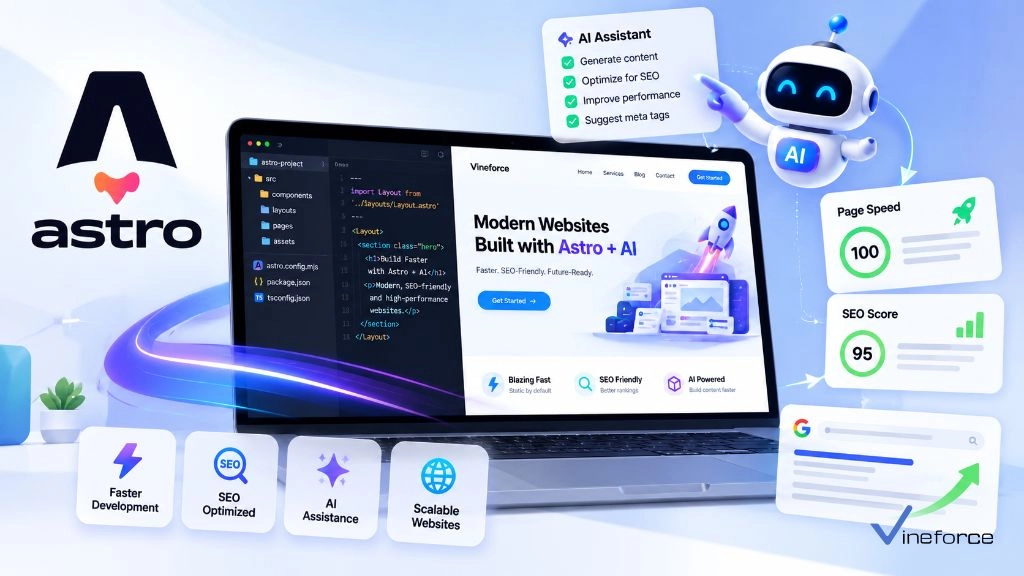
Building High-Performance Websites with Astro and AI
- Harsh Gupta
- 13 Oct, 2026
- 04 Mins read
- Development
The web landscape is undergoing a massive shift. For years, web engineering was defined by heavy JavaScript bundles, single-page application (SPA) overhead, and hydration tax that slowed down performance and punished Core Web Vitals.
Today, two powerful paradigms are redefining how we build for the web:
- Astro: An architecture designed from the ground up for speed, shipping zero JavaScript by default through its pioneering Islands Architecture.
- Artificial Intelligence (AI): Empowering developers to automate content, personalize UX, provide smart semantic search, and deploy intelligent agents directly into web workflows.
Together, Astro and AI form the ultimate modern stack for building lightning-fast, highly discoverable, and intelligent websites.
1. The Bottlenecks of Traditional Web Architecture
Before understanding why Astro and AI are so transformative, let’s look at the historical bottleneck of modern web apps:
Traditional SPA / Full-Hydration Framework:
User visits URL ──► Downloads Huge JS Bundle ──► JS Parsed & Executed ──► Page Hydrated ──► Interactive
                                   ▲
                                   └─ High CPU load, slow LCP & INP on mobile devices!
In traditional monolithic frameworks, every visitor pays the price for full-page client hydration—even on pages that are 90% static text and images. This hurts:
- Time to Interactive (TTI) & Interaction to Next Paint (INP): Mobile CPUs choke on script evaluation.
- Search Engine Crawlability: Search bots expend precious crawl budgets rendering client-heavy pages.
- Server and Bandwidth Costs: Bloated assets waste data for both users and hosts.
2. Why Astro Wins: Zero JavaScript by Default
Astro takes a fundamentally different path. It treats HTML as the primary citizen of the web.
Astro Islands Architecture:
┌─────────────────────────────────────────────────────────────┐
│ Header (Static HTML)                                        │
├─────────────────────────────────────────────────────────────┤
│ Hero Section (Pure HTML/CSS - 0 KB JS)                      │
│                                                             │
│  ┌─────────────────────────┐   ┌──────────────────────────┐ │
│  │ Interactive Filter      │   │ AI Chat Assistant        │ │
│  │ [client:visible React]  │   │ [client:idle Svelte/Vue] │ │
│  └─────────────────────────┘   └──────────────────────────┘ │
│                                                             │
├─────────────────────────────────────────────────────────────┤
│ Footer (Static HTML - 0 KB JS)                              │
└─────────────────────────────────────────────────────────────┘
The Key Advantages of Astro:
| Feature | What It Delivers | Real-World Impact |
|---|---|---|
| Zero JS by Default | Pure HTML & CSS generated ahead of time | Near-perfect 100/100 Google Lighthouse scores |
| Islands Architecture | Client interactivity isolated to standalone widgets | Only load JavaScript where user interaction is strictly required |
| Framework Agnostic | Use React, Vue, Svelte, Preact, or Solid side-by-side | Use existing component libraries without team lock-in |
| Content Collections | Type-safe Markdown and MDX management | Schema validation for blogs, docs, and product catalogs |
| Hybrid & SSR Capabilities | Prerender static pages, SSR dynamic routes | Seamless blend of static speed and edge dynamic rendering |
3. Supercharging Astro with AI: Four Powerful Use Cases
Where Astro provides raw architectural speed, modern AI gives your website brains. Here is how modern web development teams are combining both.
A. Intelligent Semantic Search & Vector Embeddings
Traditional full-text search relies on exact keyword matches. By connecting your Astro content pipeline with AI embeddings (like OpenAI text-embedding-3-small or local embedding models), your visitors can search concepts rather than exact strings.
┌─────────────────────┐      Build Pipeline      ┌──────────────────────┐
│ Astro Content Docs  │ ───────────────────────► │ Generate Embeddings  │
│ (MDX / Markdown)    │                          └──────────┬───────────┘
└─────────────────────┘                                     │
                                                            ▼
                                                 ┌──────────────────────┐
                                                 │ Vector Index / Edge  │
                                                 │ (Pinecone / Cloudflare)
                                                 └──────────▲───────────┘
                                                            │ Query
┌─────────────────────┐                             ┌───────┴───────────┐
│ User Search Query   │ ──────────────────────────► │ Cosine Similarity │
│ "how to make faster"│                             │ Returns Top Posts │
└─────────────────────┘                             └───────────────────┘
Because Astro supports server endpoints and edge rendering, you can expose a lightweight vector query endpoint:
// src/pages/api/search.json.ts
import type { APIRoute } from 'astro';

export const POST: APIRoute = async ({ request }) => {
  const { query } = await request.json();

  // 1. Convert user query to vector via AI embedding
  // 2. Query edge vector database
  // 3. Return ranked matching articles

  return new Response(JSON.stringify({ results: [] }), {
    headers: { 'Content-Type': 'application/json' },
  });
};
B. Isolated AI Chatbots Without Page-Weight Penalty
Embedding an AI assistant into a traditional website often adds hundreds of kilobytes of UI libraries and state managers.
With Astro, your AI assistant can be an isolated island:
---
// src/pages/index.astro
import Layout from '../layouts/Base.astro';
import AiAssistant from '../components/AiAssistant.tsx';
---

<Layout title="Home">
  <article>
    <!-- 100% static content rendered instantly -->
    <h1>Welcome to our knowledge portal</h1>
    <p>Read our high-performance technical guides below.</p>
  </article>

  <!-- Interactivity only loads when the user scrolls down or idles -->
  <AiAssistant client:idle />
</Layout>
The user enjoys an instant first paint, while the AI chat widget hydrates quietly in the background without blocking the main browser thread.
C. Automated Metadata, Summaries, and SEO
Maintaining schema tags, Open Graph meta descriptions, and structured data across hundreds of articles can be tedious. With Astro’s content schema hooks and build-time AI scripts, you can automate this:
- AI-Generated TL;DR Highlights: Provide quick bullet summaries at the top of long-form articles.
- Dynamic Alt Text & Accessibility: Automatically describe figures and code diagrams for assistive technologies.
- Targeted FAQ Generation: Extract structured JSON-LD questions and answers to win rich search snippets on Google.
Markdown Draft ──► Astro Build Hook ──► AI Schema Validator ──► Validated HTML + SEO JSON-LDD. AI-Driven Personalization at the Edge
Astro’s hybrid rendering mode allows you to render static pages on CDN edges, while dynamically injecting personalized recommendations using lightweight AI inference (such as Cloudflare Workers AI or Vercel Edge Functions).
The result: users receive personalized content recommendations based on browsing intent, with zero latency penalties.
4. Comparing the Approaches
| Metric / Dimension | Traditional Full-Hydration App | Astro + AI Optimized Site |
|---|---|---|
| Initial JS Shipped | 200 KB – 1.5 MB+ | 0 KB – 25 KB |
| First Contentful Paint (FCP) | 1.8s – 3.5s | 0.4s – 0.8s |
| Interaction to Next Paint (INP) | Frequently degrades under heavy hydration | Sub-50ms (Optimal Green) |
| SEO & Crawlability | Dependent on bot JS execution | Instant native HTML parse |
| AI Integration Overhead | Bloats the central application bundle | Isolated to lazy-loaded islands |
5. Practical Steps to Upgrade Your Website Today
- Audit Your JavaScript Budget: Identify pages where client-side interactivity is unnecessary (such as marketing homepages, blogs, and documentation).
- Migrate to Astro: Adopt Astro’s file-based routing and move existing React/Vue components into Astro templates, applying
client:load,client:visible, or no directive at all. - Decouple AI Features into Islands: Keep your heavy chat, search, or recommendation modules inside targeted islands.
- Automate Build-Time Content Workflows: Integrate lightweight AI scripts during your CI/CD step to generate summaries, tags, and validated schemas.
Frequently Asked Questions (FAQ)
What makes Astro faster than traditional Single Page Application (SPA) frameworks?
Astro ships zero JavaScript to the browser by default. It pre-renders your pages into static HTML and CSS at build or request time, hydrating interactive UI components (“islands”) only when explicitly requested by client directives.
How does AI complement an Astro-powered website?
AI accelerates every phase of the site lifecycle. It streamlines content generation, automated semantic SEO tagging, and smart search embeddings, while enabling dynamic AI features like chat widgets or recommendation modules integrated via Astro’s isolated client islands.
Can I use React, Vue, or Svelte inside an Astro project?
Yes. Astro is completely framework-agnostic. You can blend React, Vue, Svelte, Solid, or Alpine components on the same website and even on the same page without extra configuration.
Conclusion
Building faster, smarter websites is no longer a tradeoff between developer productivity and end-user performance. By pairing Astro’s zero-JS islands architecture with targeted AI capabilities, teams ship websites that achieve perfect Lighthouse scores, rank higher across search engines, and deliver intelligent experiences.
If you are planning to modernize an enterprise web presence or build a scalable SaaS application, discover how Vineforce architects high-performance, compliant cloud solutions tailored for modern businesses.