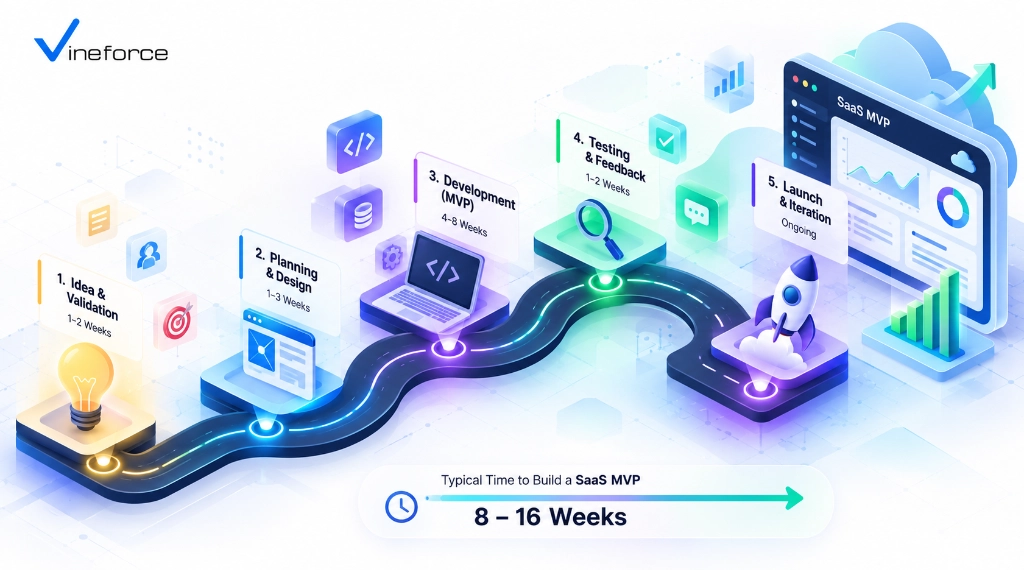
How Long Does It Take to Build a SaaS MVP in 2026? (Timeline & Acceleration Guide)
- Harsh Gupta
- 06 Sep, 2026
- 08 Mins read
- Development , SaaS , Software Architecture
For tech founders, product managers, and enterprise innovators, speed-to-market is the single most critical factor determining SaaS survival. In a competitive market, launching early allows you to validate business hypotheses, gather real user feedback, secure early revenue, and iterate before runway runs out.
However, one fundamental question stalls every product roadmap: “How long does it actually take to build a SaaS Minimum Viable Product (MVP)?”
Quick Summary: Building a custom SaaS MVP from scratch typically takes 4 to 9 months (16 to 36 weeks) because engineers spend up to 60% of their time building foundational “plumbing” like multi-tenancy, authentication, billing, and permission management. By partnering with Vineforce and leveraging our enterprise-ready framework based on ASP.NET Zero, organizations eliminate boilerplate setup and launch fully functional, production-ready SaaS MVPs in just 4 to 8 weeks. Learn more about our SaaS development solutions.
Average SaaS MVP Timelines: Custom Build vs. Vineforce Framework
When estimating how long a SaaS MVP takes to build, the answer depends heavily on your architectural approach:
| Development Approach | Typical Timeline | Time Savings | Code Ownership & Scalability |
|---|---|---|---|
| Traditional Custom Build | 16 – 36 Weeks (4–9 Months) | Baseline (0%) | Full code ownership, but long initial setup |
| No-Code / Low-Code Tools | 3 – 6 Weeks | Up to 80% Faster | High vendor lock-in, poor enterprise scale |
| Vineforce Framework | 4 – 8 Weeks (1–2 Months) | 60% – 70% Faster | Full C# Code Ownership, Enterprise Scalable |
SAAS MVP TIME-TO-MARKET COMPARISON

1. Custom From-Scratch Build
   ████████████████████████████████████ (16 - 36 Weeks)

2. No-Code / Low-Code Platform
   ██████ (3 - 6 Weeks | Limited Security & Scale)

3. Vineforce Accelerated Engine
   ████████ (4 - 8 Weeks | Enterprise Production Ready)
   ---------------------------------------------------------->
0 Wks 4 Wks 8 Wks 12 Wks 16 Wks 24 Wks 36 Wks- Traditional Custom Build (From Scratch): 16 to 36 Weeks (4 to 9 Months)
Developing everything from blank files—writing custom authentication, tenant isolation logic, role permissions, payment webhooks, and database schemas—demands extensive engineering hours. - No-Code / Low-Code Tools: 3 to 6 Weeks
Fast for simple prototypes, but severely limited by platform lock-in, poor security controls, lack of custom database ownership, and inability to handle complex multi-tenant enterprise workloads. - Vineforce Accelerated Framework: 4 to 8 Weeks
Combines production-grade enterprise C#/.NET 9 code with pre-built boilerplate modules, allowing developers to focus 100% of their effort on your proprietary business features from Day 1.
Phase-by-Phase Breakdown of Building a SaaS MVP
To understand how Vineforce accelerates time-to-market, let’s compare the standard development lifecycle of a custom build against the Vineforce framework approach:
| Development Phase | Custom From-Scratch Build | Vineforce Framework | Framework Impact & Time Saved |
|---|---|---|---|
| Phase 1: Discovery & Architecture | 2 – 4 Weeks Designing schemas, auth flows, and multi-tenant DB architecture from blank files | 1 Week Pre-designed enterprise architecture, entity templates, and modular design patterns | 50% – 75% Faster Rapid schema modeling using proven C#/.NET 9 templates |
| Phase 2: SaaS Infrastructure (Boilerplate) | 6 – 12 Weeks Writing multi-tenancy logic, SSO/2FA, RBAC, Stripe billing, audit logs & localizations | 0 Weeks (Instant) 100% pre-built out of the box with production-grade enterprise code | 100% Eliminated Saves 1.5 to 3 months of non-differentiating work |
| Phase 3: Proprietary Feature Engineering | 6 – 14 Weeks Building custom business logic while wrestling with infrastructure integration | 2 – 5 Weeks Engineers focus 100% on your unique value proposition & custom UI from Day 1 | 50% – 65% Faster Accelerated by ready-to-use CRUD & API generators |
| Phase 4: QA, Security & Deployment | 2 – 6 Weeks Manual cloud setups, security vulnerability patches, and CI/CD script writing | 1 – 2 Weeks Containerized Docker packages, automated test suites & Azure deployment blueprints | 50% – 60% Faster Pre-tested enterprise security & automated pipelines |
| TOTAL TIMELINE | 16 – 36 WEEKS (4–9 Months) | 4 – 8 WEEKS (1–2 Months) | 60% – 70% TOTAL TIME REDUCTION |
PHASE-BY-PHASE TIMELINE COMPARISON

Phase 1: Discovery & Architecture
Custom:    ████ (2-4 Wks)
Vineforce: █ (1 Wk)

Phase 2: SaaS Infrastructure (Boilerplate)
Custom:    ████████████ (6-12 Wks)
Vineforce: [COMPLETED OUT OF THE BOX] (0 Wks)

Phase 3: Proprietary Core Features
Custom:    ██████████████ (6-14 Wks)
Vineforce: ████ (2-5 Wks)

Phase 4: QA, Security & Deployment
Custom:    ██████ (2-6 Wks)
Vineforce: ██ (1-2 Wks)
How Vineforce Accelerates Each Development Phase
Phase 1: Product Discovery & Architecture
- Without Framework: Architects must manually evaluate and design tenant data isolation strategies (shared database vs. separate databases), token authentication schemes, and role permission structures.
- With Vineforce: Architecture patterns are already standardized following Domain-Driven Design (DDD) principles. Your team simply defines custom business entities while the Vineforce framework handles tenant mapping and API scaffolding automatically.
Phase 2: Core SaaS Infrastructure (Boilerplate)
- Without Framework: Developers spend months writing non-differentiating plumbing code—building user registration, password hashing, two-factor auth (2FA), Azure AD Single Sign-On (SSO), Stripe subscription webhooks, audit trails, and multi-language dictionaries.
- With Vineforce: 0 weeks required. Powered by an enterprise ASP.NET Zero license, all infrastructure modules are fully implemented, pre-tested, and ready to use immediately upon project start.
Phase 3: Proprietary Feature Engineering
- Without Framework: Developers constantly context-switch between writing core business logic and fixing infrastructure bugs or database migration issues.
- With Vineforce: Engineering teams jump straight into writing your unique value-add features. Integrated code generators create UI pages, Angular/React components, DTOs, and application services instantly.
Phase 4: Quality Assurance, Security & Cloud Deployment
- Without Framework: DevOps engineers must build deployment pipelines, write Dockerfiles, configure Web Application Firewalls, and conduct extensive security testing from scratch.
- With Vineforce: Pre-configured Docker Compose scripts, Azure Bicep templates, and security hardening guidelines allow push-button staging and production deployments.
Total Custom Build Time: 16 to 36 Weeks (4 to 9 Months)
Vineforce Accelerated Build Time: 4 to 8 Weeks (1 to 2 Months)
The “Boilerplate Trap”: Why 50–60% of Dev Time is Wasted
Why do so many SaaS startups miss their target launch dates?
The primary culprit is the Boilerplate Trap. Every business-to-business (B2B) SaaS product requires the exact same foundational architecture before a single line of domain-specific code can execute:
+-----------------------------------------------------------------------------------+
|                         THE SAAS BOILERPLATE ICEBERG                              |
+-----------------------------------------------------------------------------------+
|  WHAT USERS SEE (40% of Code)    :  [ Proprietary Feature Logic & Custom UI ]      |
+-----------------------------------------------------------------------------------+
|                                  :  --------------------------------------------  |
|  WHAT YOU MUST BUILD (60% Code)  :  [ Multi-Tenancy Architecture            ]      |
|  (Non-Differentiating Boilerplate):  [ Authentication & 2FA / SSO            ]      |
|                                  :  [ Role Permissions & Organization Units ]      |
|                                  :  [ Stripe Subscriptions & Billing Engine ]      |
|                                  :  [ Audit Logs & Security Telemetry       ]      |
|                                  :  [ Notification Systems & Localizations  ]      |
+-----------------------------------------------------------------------------------+
When building from scratch, your development team spends months writing code that your customers take for granted. Re-inventing user logins, password hashers, permission checks, and payment webhooks does not make your product unique—it simply consumes your funding and delays your launch.
How Vineforce Cuts MVP Development Time by 60–70%
By eliminating the need to write infrastructure code from scratch, Vineforce enables founders to bypass the entire 6-to-12-week boilerplate phase.
As an official ASP.NET Zero partner, Vineforce leverages an enterprise-licensed starter engine built on ASP.NET Core (.NET 9) and modern front-end frameworks (Angular/React). Vineforce provides a ready-to-use application foundation containing all essential enterprise features out of the box.
+-----------------------------------------------------------------------------------+
|                 VINEFORCE ACCELERATED SAAS DEVELOPMENT ENGINE                     |
+-----------------------------------------------------------------------------------+
|                                                                                   |
|  +-----------------------------------------------------------------------------+  |
|  | VINEFORCE PRE-BUILT SAAS ENGINE (ASP.NET Zero Licensed Foundation)          |  |
|  | • Multi-Tenancy  • SSO / OAuth2  • Granular RBAC  • Stripe/PayPal Billing     |  |
|  | • Audit Logs     • User Management • Notifications • Language Localization  |  |
|  +-----------------------------------------------------------------------------+  |
|                                       |                                           |
|                                       v                                           |
|  +-----------------------------------------------------------------------------+  |
|  | VINEFORCE DEDICATED ENGINEERING TEAM                                        |  |
|  | • Focus 100% on your unique business domain & custom features                 |  |
|  | • Tailored UI/UX integration & custom API engineering                       |  |
|  | • Docker containerization & Azure CI/CD automated deployment                  |  |
|  +-----------------------------------------------------------------------------+  |
|                                                                                   |
+-----------------------------------------------------------------------------------+
What You Get Instant Access To with Vineforce:
- Enterprise Multi-Tenancy: Built-in support for tenant isolation, custom tenant subdomains (e.g.,
tenant.yourdomain.com), and host-versus-tenant administrative portals. - Identity & Security Framework: Pre-integrated JWT authentication, two-factor authentication (2FA), and Single Sign-On (SSO) with Azure AD, Google, and Microsoft.
- Role & Permission Management: Declarative permission rules attached to specific user roles or organization units, configurable right from the UI.
- Subscription & Billing Engine: Automated recurring billing, trial periods, invoice generation, and webhooks integrated directly with Stripe and PayPal.
- Audit Logs & Security Auditing: Automated recording of every entity change, user action, and IP address for compliance.
- Localization & Multi-Language Support: Fully extensible translation system supporting dynamic multi-language switching.
Instead of spending 3 months creating infrastructure, Vineforce developers start building your custom proprietary features on Day 1.
To learn more about our development services, read about the Vineforce partnership with ASP.NET Zero.
Architectural Comparison: Custom vs. No-Code vs. Vineforce Framework
| Capability / Metric | Custom From-Scratch Build | No-Code / Low-Code Platforms | Vineforce Framework |
|---|---|---|---|
| Time-to-Market | 16 – 36 Weeks (4–9 Months) | 3 – 6 Weeks | 4 – 8 Weeks (1–2 Months) |
| Development Cost | High ($50k – $150k+) | Low Initial / High Lock-In | Medium-Low (Up to 50% Savings) |
| Code Ownership | 100% Owned | 0% (Locked in Vendor Platform) | 100% Full C# Source Code Ownership |
| Multi-Tenancy | Complex custom build | Poor or non-existent | Native Out-of-the-Box |
| Enterprise Security | Dependent on dev team skill | Limited platform security | Enterprise-Grade (.NET 9 Standards) |
| Custom Extensibility | Unlimited (High cost) | Restricted by platform limits | Unlimited (Modular C# / Web Architecture) |
| Scalability | High (Requires custom effort) | Poor (Fails at high load) | Proven to scale to millions of users |
| Database Access | Direct SQL Access | Vendor-restricted | Direct SQL / EF Core Access |
Common Factors That Delay SaaS MVP Launches (And How to Avoid Them)
Even with an accelerated framework, product teams often encounter scope creep and operational delays. Here are the top bottlenecks and how to prevent them:
1. Over-Engineering the Initial Scope (Feature Creep)
- The Mistake: Trying to build every feature suggested by stakeholders before launching.
- The Solution: Stick strictly to the One Core Problem rule. Identify the single primary workflow that solves your user’s pain point. Leave non-essential features for Post-MVP iterations.
2. Building Custom Authentication & User Portals
- The Mistake: Spending weeks writing custom password reset routines, email verifications, and permission trees.
- The Solution: Use pre-built identity modules provided by enterprise boilerplates.
3. Unclear API & UI Specifications
- The Mistake: Changing database schemas and front-end layouts mid-development.
- The Solution: Work with experienced engineering managers to freeze core entity schemas and wireframes during a 1-week sprint zero.
4. Complex Cloud Infrastructure Configuration
- The Mistake: Struggling with manual server setups and configuration errors right before launch.
- The Solution: Leverage containerized Docker deployments and pre-built Azure CI/CD pipelines. Read our detailed guide on Docker for SaaS deployment.
Actionable Blueprint: How to Launch Your SaaS MVP in 6 Weeks with Vineforce
Here is the exact step-by-step roadmap Vineforce uses to deliver production-ready SaaS MVPs in 4 to 8 weeks:
+-----------------------------------------------------------------------------------+
|                   VINEFORCE 6-WEEK SAAS MVP LAUNCH ROADMAP                        |
+-----------------------------------------------------------------------------------+
|  WEEK 1  | Product Blueprint & Architecture Setup                             |
|          | • Define core user journeys & freeze ERD schemas                       |
|          | • Initialize Vineforce boilerplate repository & host database          |
+----------+------------------------------------------------------------------------+
|  WEEK 2  | UI Theme Customization & Core Feature Sprint 1                         |
|          | • Apply brand design system & customized Angular/React layout          |
|          | • Implement primary domain entity APIs and business services           |
+----------+------------------------------------------------------------------------+
|  WEEK 3-4| Core Feature Sprint 2 & Integration                                    |
|          | • Complete unique workflow tools, dashboards, & third-party APIs       |
|          | • Configure Stripe payment tiers & subscription plans                  |
+----------+------------------------------------------------------------------------+
|  WEEK 5  | Quality Assurance, Security Auditing & UAT                             |
|          | • Run automated unit tests, RBAC permission audits, & load testing    |
|          | • Client walkthrough & user acceptance testing                         |
+----------+------------------------------------------------------------------------+
|  WEEK 6  | Cloud Deployment & Launch                                              |
|          | • Provision Azure App Services / AWS environment via Docker            |
|          | • Domain DNS routing, SSL certificates, & live production launch       |
+-----------------------------------------------------------------------------------+
If you are looking for specialized developers to execute your roadmap, check out our guide on how to hire ASP.NET Zero developers.
Frequently Asked Questions (FAQ)
How long does it take to build a SaaS MVP on average?
Building a custom SaaS MVP from scratch typically takes 4 to 9 months (16 to 36 weeks). However, using Vineforce’s accelerated SaaS framework reduces this timeline to just 4 to 8 weeks.
What is a SaaS MVP?
A SaaS Minimum Viable Product (MVP) is a functional early version of a software-as-a-service application built with core features to validate market demand, onboard early users, and collect feedback.
Why does building a SaaS MVP from scratch take so long?
Up to 50% to 60% of development time in custom builds is spent writing infrastructure boilerplate—such as multi-tenant database isolation, user authentication, role-based access control (RBAC), subscription billing, audit logs, and payment webhooks.
How does Vineforce accelerate SaaS MVP development?
Vineforce leverages a production-ready enterprise framework built on ASP.NET Zero, providing pre-built multi-tenancy, user management, authentication (SSO/OAuth), subscription management, localizations, and audit trails out of the box.
How does Vineforce help reduce SaaS MVP build time?
Vineforce provides experienced, certified engineering teams, ready-to-use UI templates, CI/CD deployment pipelines, and custom module extensions—delivering fully functional MVPs in 4 to 8 weeks.
What core features should be included in a SaaS MVP?
A SaaS MVP should focus on 1-2 core value-add features alongside essential SaaS infrastructure: multi-tenant user authentication, basic role permissions, subscription billing, and responsive dashboards.
Is no-code faster than Vineforce for building a SaaS MVP?
No-code tools allow rapid prototyping in 2-4 weeks but lack scalability, security, custom database ownership, and enterprise multi-tenancy. Vineforce offers production-grade code, full customization, and enterprise scalability.
How much does it cost to build a SaaS MVP?
Custom agency builds from scratch range between $40,000 and $120,000+. Accelerated development using Vineforce’s framework significantly reduces engineering hours, cutting costs by up to 50%.
Can a SaaS MVP built by Vineforce scale to enterprise level?
Yes. Vineforce builds on .NET 9 and Angular/React with modular architecture, supporting millions of users and high-concurrency multi-tenant enterprise deployments without requiring a rewrite.
What technologies does Vineforce use for SaaS MVP development?
Vineforce leverages C#, .NET 9, ASP.NET Zero, EF Core, PostgreSQL/SQL Server, Angular/React, Docker, and Microsoft Azure for high-performance SaaS applications.
Ready to Build Your SaaS MVP in Weeks Instead of Months?
Don’t let months of infrastructure development delay your market launch. Partner with Vineforce to turn your SaaS vision into a scalable, production-ready product in weeks.
Explore our official Vineforce ASP.NET Zero Partnership or discover how our team of certified developers can accelerate your product roadmap today.